

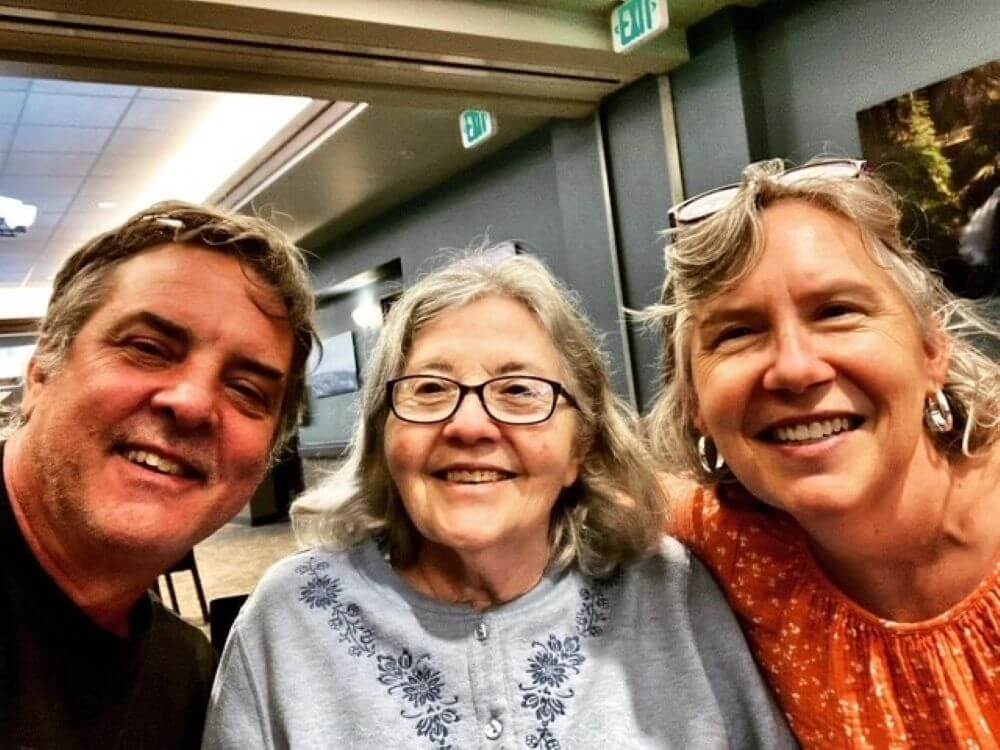
Sandra (Feld) Swain, 83, died Feb. 19, 2026, at Fieldstone Memory Care in Olympia. Her death followed a long decline from dementia that took root more than10 years ago, rendering this smart, funny, vibrant woman a shell of her former self—although pieces of her personality lingered in her laugh and a particular knowing look until the very end.
She was born in Chicago on Nov. 23, 1942, to Dorothy Jewett and Sanford Feld. (Her birthday was only a few days apart from former President Joe Biden and we felt sure she would outlive him.) Growing up on Chicago’s southside, our mom was a city gal through and through. She never anticipated that her life married to a public health doctor would take her to some of the more remote parts of the world—places where palm trees and wild pigs were more common than sidewalks and traffic lights.
She graduated from Bowen High School in 1960 and after graduating from the University of Illinois in 1964 with an English degree she headed west with her friend Barbara to San Francisco. They made their bold cross-country trek before it became the “in” place to be in the later 1960s. Our mom often remarked that the hippie good times of that era seemed like something that happened in the room next door.
She tried her hand at being a secretary but wasn’t good at filing or organization. She was much better working as a grocery store checker and she often remembered her times as a teenager working the cash register at Jewel grocery stores in Chicago. She eventually returned to Illinois and earned her master’s degree in English from UI. It was while living in Champaign, Ill., that she met our dad, a general practice doctor who was recently divorced and had four children.
Those children—our half-siblings, John, Beth and David—became close to us younger Swain offspring as we grew up. Our oldest half-sibling, James, lived with severe autism and other significant mental health challenges and was later institutionalized—a source of deep sorrow for our dad and one that echoed years later in the struggles our brother Sanford would face. We remain grateful for a family bound by generosity and acceptance, especially siblings from a previous marriage who might easily have felt resentment but instead welcomed us with warmth.
My mom married our dad Juan Robert (J.R.) Swain at the end of 1967, and he took a job with the federal Food and Drug Administration in Washington, D.C. The couple’s oldest daughter, Marina, was born two years later in Alexandria, Virginia. The family then moved to Portage, Mich., so our dad could work at Upjohn, a pharmaceutical company in Kalamazoo, Mich. Sons Sanford and Preston were born during those years in the early 1970s. The family took a bold leap when our dad accepted a job as a Public Health Service doctor, moving the young family to the heart of the Pacific to serve on the remote tropical island of Majuro in the Marshall Islands—about halfway between Hawai’i and Australia. Our mom, a lifelong Chicagoan, must have found it both thrilling and overwhelming: raising three kids far away from anywhere, gathering and boiling water collected in a cistern, learning about the Marshallese traditions of weaving palm fronds and sleeping on mats, and exploring the beaches alongside our dad in their “reef walker” shoes. They had their fourth child, Chloe, on the island of Kwajalein (a secure island used by the U.S. military), so our mom could deliver her daughter in an up-to-date hospital, right near the international date line.
The Swain family then moved to Novato, Calif., and stayed with our mom’s friend Barbara Renzullo, who had settled in California after leaving Illinois with my mom all those years ago. Our dad, now nearing 50 decided to begin a second career, or perhaps third or fourth, as a doctor in the U.S. Coast Guard. The family’s first station was Kodiak, Alaska, a small island in the Gulf of Alaska, surrounded by dense spruce forests and dark gray sand beaches draped in fog. The bus that took the older kids to school was also a military dark gray, as was the weather for much of the year. Our dad trained to become a flight surgeon and would help with helicopter water rescues of capsized fishermen and sailors in the frigid waters. My mom, now the mother of four young children, became a Coast Guard wife and learned to navigate the hierarchy of the military and supporting our dad’s new career. This was not always easy, but she made close friends with a few other wives, including some who would become lifelong friends.
The family eventually moved away from rugged Alaska winters into bright sunshine when our dad was stationed in Aguadilla, Puerto Rico, The family lived in a two-story, tile-floored home that looked out on the Atlantic Ocean. The backyard was filled with banana plants and other tropical fruits and flowers. Our mom loved the tropics, and anything woven from rattan—rattan furniture, exotic cushions, and Asian-influenced artwork moved with us throughout our growing up years, even to decidedly northern homes in Michigan and Oregon. In Puerto Rico, she would harvest fresh limes from the backyard (steering clear of aggressive jumbo-sized Puerto Rican “black bees”) and gather avocados that hung in clusters from a tree overhanging the second-floor porch. She disliked air conditioning, so we lived with the louvers open and fans spinning in every room. A cutting-edge home cook, she served meals of rice, chicken and fresh salads; we were certainly not a meat-and-potatoes family.
In the early 1980s, we moved again, this time to Traverse City, Michigan and a Coast Guard station serving the Great Lakes region. As kids, we were fascinated by the dramatic shifts of four seasons after years in the steady heat of the tropics. For our mom, however, it was a kind of homecoming: snow in the winter, vibrant fall leaves, and everything in between. Growing restless while caring for four kids under the age of 12, she returned to school, earning an associate degree in computers and technology from the local community college. My mom, always an early-technology adopter, made sure the family had the latest Apple computers and dot-matrix printers. At this point, our mom also introduced the family to her love of dogs, when the family adopted a purebred fox terrier puppy, named Terry. Our mom had long brought plenty of kitties along the family’s journey. At one point, she had even bred Balinese cats—fluffy long-haired cats with Siamese markings and stunning sapphire-blue eyes. The family now had at least one cat and sometimes two dogs, plus two tanks of fish, and one hapless yellow parakeet named Mork. (A story for another time). My mom was good at training dogs to follow directions—skills she put to use in raising her human children (well, most of the time!).
In the mid-1980s, the family moved one more time, to Astoria, Oregon, where our flight surgeon dad was posted at a Coast Guard air station known for being one of the busiest search and rescue units, due to dangerous waters near the Columbia River Bar (dubbed the “Graveyard of the Pacific.”) During these years, our mom kept things running at a lively pace with a chattering “police scanner” in the kitchen, a Nordic track ski machine (also in the kitchen) and too many teenagers coming and going to count. Our mom always welcomed our friends and kept our downstairs freezer fully stocked. Some friends even slept on the pool table downstairs. (Also a story for another time.) Our mom became a committed volunteer and later leader of the Lower Columbia Youth Soccer Asociation. All four kids played soccer and most of us also became referees—a demanding first job that teaches all kinds of life lessons. (Thanks mom!)
Once the kids began to leave the nest for college, our mom began her next career—as a radio disc jockey (!). Her older daughter had worked at the station one summer and the next thing you know she found a way to get in the door, and on the air. Our mom was a real-life radio personality and had a radio-friendly name, that was not fabricated but actually hers. She later served as the news director at KAST radio, reading the news as the station towers blinked red along the shores of Youngs Bay. After the station experienced economic challenges, she transitioned to working as a reporter at The Daily Astorian newspaper.
Our mom thrived as a journalist, tracking down stories, building relationships, and putting those years of listening to the police scanner in our kitchen to use. She was particularly interested in the beat called “cops and courts,” and covered a lot of trials, including big stories covered by Court TV. Yes, Astoria is the Bermuda Triangle of news—a LOT happens in this coastal community at the edge of the continent.
Our parents later divorced, but my mom was satisfied working as a journalist, playing with her Jack Russell terriers Dotty and Leo, and fixing up her own home, which included enviable views of the Astoria bridge. After our mom retired from her career in journalism, she moved to Olympia to be closer to her oldest child, Marina and her then husband Don, who had two young sons ready to welcome grandma. The Olympia location also made it easier for her to see her two other adult children, Chloe Swain, in Burien and Preston Swain, in Portland, both of whom went on to have children of their own. Our mom was eventually a grandmother of six, including Jackson Parr, 23; Simon Parr, 20; Kai Bjordahl, 16; Bo Bjordahl, 14; Summer Swain, 9; and Lacey Swain, 6.
This obituary would not be complete without speaking to the family’s loss of our brilliant brother Sanford Swain, a heartbreak and hole that can never be filled. My mother mourned her second born following his death at 27. So much of our family’s early days included his incredible humor and intellect. There were rarely dull moments, or dull conversations, in our household thanks to Sanford—and my mom nurtured his offbeat eccentricities, including when he got mail delivered to our household addressed to Dmitry Ustinov, a Soviet military leader. Sanford struggled for years with schizophrenia before ending his own life, a family tragedy that ripples right below the surface.
All of this is to say that although this obituary is VERY long, it is not nearly long enough to capture the full life of a person as amazing as our mom. So many struggles go unremarked, but are pivotal in a life. If you’ve read this far, you likely know our mom pretty well and can think of so many other pieces of this puzzle that were not noted here. Hold onto those pieces because they are all true and are part of the glue that hold together the full person.
Our mom could be sharp and shrill. She could be overbearing. She could more than hold her own in a conversation, fired up by her intellect and passion. She could also hold your hand and comfort you. She could give a hug and recognize your gifts and celebrate them. She could also play a mean first base on a softball team and share her beautiful alto voice in choirs across many communities.
When her dementia began around 2014-15, we noticed the sharp edges softening, wearing away like water over stone. She would point to the trees, marveling at the beauty of their leaves. A new, “nicer” mom, but one that was headed for so much pain, and fear, as dementia took over. We want to thank all of our friends and family for their help and support over the many years our mom endured this cruel disease, her brilliant mind unraveling before our eyes.
In particular, a heartfelt thanks to my former husband, Don Parr, who helped my mom through the years, while she was still living independently—sitting with her, turning on a favorite classic TV show, sharing a beer to help calm her, and patiently fixing the TV remote or restarting her computer for the umpteenth time. I am also deeply grateful to my husband Alan Jackson, who cared for her over many years as well, visiting when we were out of town and bringing her pizza, companionship, and kindness when she needed it most. Alan also was a big part of our memory care visits, painting my mom’s nails, putting her long gray hair in a French braid, baking her homemade birthday cakes, hugging her and whispering how much we love her. I feel so fortunate that her long journey is finally over and that I have so many loving people in my life.
Memorial
There will be no formal funeral service for our mom. Our family will come together privately to remember her, sharing her favorite foods and the music she loved most.