The brain is home to approximately 171 billion cells. Half of those are neurons, the most well-known type of brain cell. Neurons take credit for orchestrating our movements, thoughts, and feelings. They make everything happen. But while neurons take center stage to great applause, it is the other brain cells, the supporting cast, that ensure neurons continue their headlining role. One cell type, called astrocytes, is gaining acclaim for the ways it nurtures and assists neurons.
The brain is roughly equal parts neurons and supporting cells called glia. Glia literally means glue, and for a long time, scientists disregarded glia as nothing more than the paste filling the nooks and crannies between neurons and holding the brain together. But, as technology improved and scientific exploration marched on, scientists began to realize glia were much more than brain-packing material. In fact, glial cells represent a diverse population of cells that support neurons in unique ways. Astrocytes are one type of glial cell.
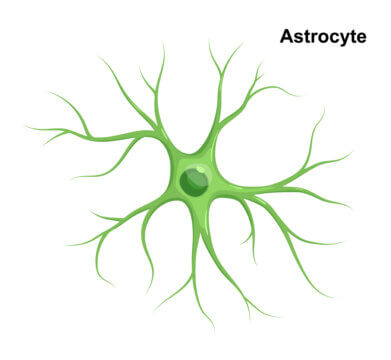
Astrocytes are neuron nurturers. They lay the foundation for neurons to develop and the brain to form. They have numerous arms radiating from their bodies, giving them the star-like appearance that inspired their name (astro means star). These arms wrap around synapses, the specialized connections between neurons where communication happens. Neurons release chemical signals called neurotransmitters into the synapses to talk to each other. However, if there is too much neurotransmitter in the synapses or if it lingers too long, neurons can get overexcited and die. Astrocytes protect and calm neurons by removing excess neurotransmitters. This cultivates a healthy, safe environment for neurons to communicate. In humans, one astrocyte can interact with 1 to 2 billion synapses.
Astrocyte arms also surround blood vessels in the brain, creating a bridge between the bloodstream and neurons. This allows astrocytes to feed neurons with nutrients from the blood and transport packaged waste from neurons back into the blood for removal. Like mothers nurturing their children, astrocytes feed neurons and clean up after them.
Recently, a study supported by CureAlz showed that in mice, astrocytes, like neurons, form organized webs that stretch across the brain and connect distant regions. These connections are not random. They show that in addition to caring for neurons, astrocytes allow the brain to communicate in ways we haven’t seen before.
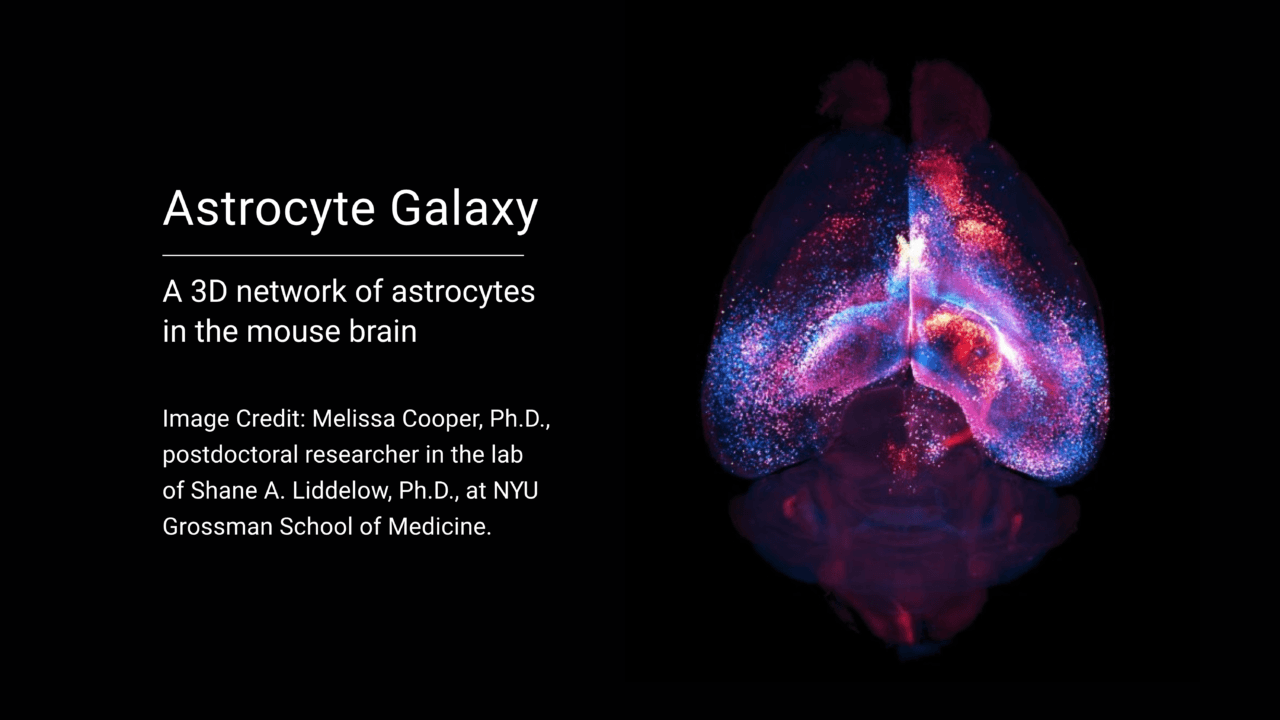
These extensive networks are seen in the leading image above and featured on the cover of the CureAlz 2025 Annual Report. The image is created by Melissa Cooper, Ph.D., a postdoctoral researcher in the lab of Shane A. Liddelow, Ph.D., at New York University Grossman School of Medicine. She used a trick of light to make a mouse brain translucent and then color-coded the astrocytes. Blue astrocytes are closer to the viewer; red astrocytes are further away. The result is a galaxy of star-like astrocytes dotted across the mouse brain, creating an elaborate communications network.
Rather than mirroring neuronal networks, astrocyte networks connect areas not already joined by neurons. These pathways are dynamic and shaped by experiences, such as sensory input. For example, whiskers are one of a mouse’s most important senses. Mice use their whiskers to interact with their surroundings and recognize objects. When researchers trimmed whiskers on one side of a mouse’s face, astrocyte pathways from brain regions that process whisker touch shrank and rerouted to different astrocytes.
Our understanding of astrocytes has come a long way from the initial assumption that they were nothing more than cement holding the brain together. They play vital roles in nurturing and supporting neurons and run their own independent signaling networks. Astrocytes are proving to be stars in their own right.
Watch this video to learn more about astrocytes and how the leading image was created:
To learn more about astrocytes and their role in inflammation, watch Dr. Shane Liddelow’s webinar, “What’s the Role of Inflammation in Alzheimer’s Disease?”