Named in honor of the late Co-Founder of Cure Alzheimer’s Fund, Jeffrey L. Morby, the Prize is awarded annually to the senior and first authors of a timely scientific publication that transforms the fundamental understanding of Alzheimer’s disease and opens new paths to translate scientific results into effective ways to prevent, diagnose or treat the disease.
2026 Winners
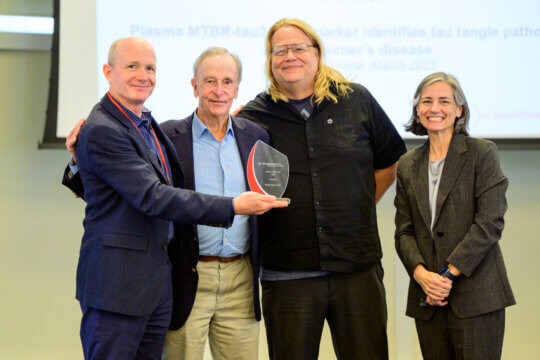
From Left: Randall J. Bateman, M.D., Henry McCance, Drew Morby, and Meg Smith.
The 2026 Jeffrey L. Morby prize is awarded for the paper, “Plasma MTBR-tau243 biomarker identifies tau tangle pathology in Alzheimer’s disease,” published in the journal Nature Medicine in March 2025. It details the development of a new blood test that, for the first time, accurately detects toxic tau levels in the brain and can indicate how far Alzheimer’s disease has progressed.
The award is shared by senior co-authors Drs. Randall J. Bateman and Oskar Hansson, and first coauthors Drs. Kanta Horie and Gemma Salvadó.
The gold standard for diagnosing and staging Alzheimer’s disease is positron emission tomography (PET) scans to detect amyloid plaques and tau tangles. While PET scans are accurate, they are also expensive and require specialized facilities. This puts them out of reach for most patients. Blood tests, on the other hand, are cheaper and a more accessible option for patients seeking answers about the cause of their symptoms.
While several blood tests are currently clinically available that help diagnose Alzheimer’s and track amyloid plaque levels, none can directly reflect tau tangles, which track more closely with symptoms than amyloid, or stage the disease.
A new test developed by the Jeffrey L. Morby prize winners changes that. The test detects blood levels of a protein called MTBR-tau243 that accurately reflect the amount of tau tangles in the brain. As MTBR-tau243 levels rise in the blood, the severity of the disease also increases. Using only the blood test, scientists could distinguish between early and later stages of the disease. It could also separate Alzheimer’s patients from people whose cognitive symptoms were caused by something else, proving the test is also effective at distinguishing Alzheimer’s from other forms of dementia.
In addition to diagnosing and staging the disease, the blood test provides doctors with an easy, accessible way to determine whether the current FDA-approved anti-amyloid treatments are appropriate for their patients. These treatments are most effective when given to patients in the earliest stages of the disease when tau tangle levels are low. As potential new treatments targeting tau pathology enter clinical trials, this test can also be used to identify study participants and determine whether a treatment successfully reduces tau tangles.
The test is not yet clinically available, but researchers hope it could soon offer an accessible alternative to tau-PET scans for diagnosing and staging Alzheimer’s disease.
“The Morby prize recognizing our collaborative effort to bring tau tangles blood biomarkers to researchers, doctors, and patients acknowledges the incredible impact and promise that being able to detect and measure Alzheimer’s pathology in the brain has for our field. This advanced test is already being used in clinical trials and research studies, and, in the future, in the clinic to benefit our patients and families in having secure knowledge of Alzheimer’s and treatment options.” — Randall J. Bateman, M.D.
2025 Winners
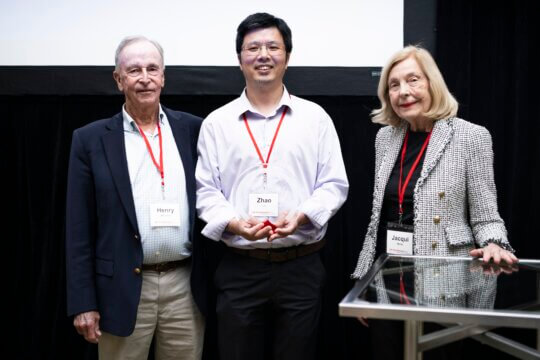
From Left: Henry McCance, Zhao Sun, Ph.D., and Jacqui Morby.
The paper describes a groundbreaking method to study aged neurons in the lab without requiring a brain biopsy, enabling more accurate modeling of late-onset Alzheimer’s disease. By transforming skin cells from patients directly into neurons that reflect the aging process, scientists now can observe key disease features, such as amyloid beta plaque buildup, offering new insights into Alzheimer’s disease development and potential treatment approaches.
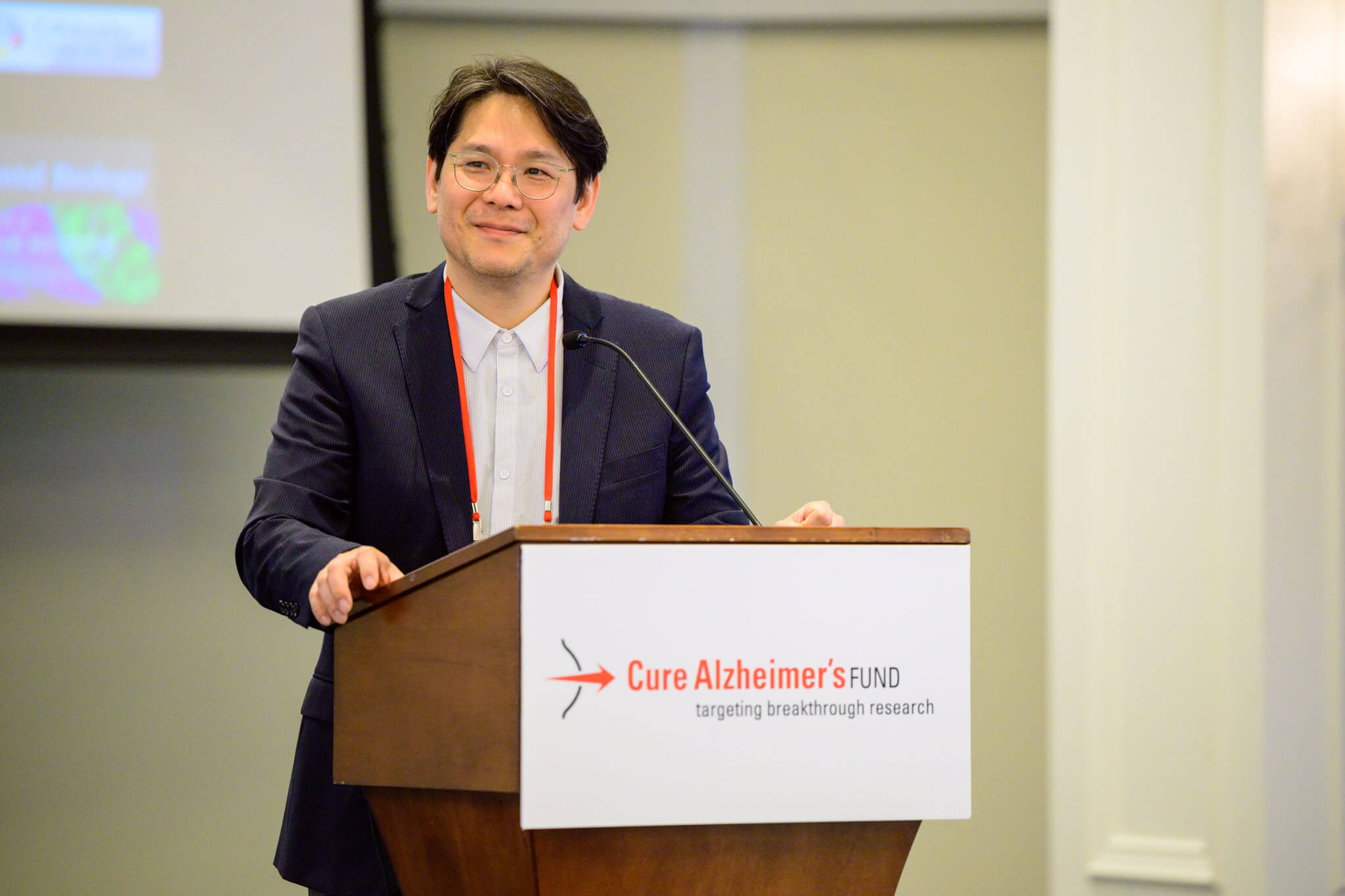
“With the demonstration that direct neuronal reprogramming can model neuropathological features of late-onset Alzheimer’s disease, this method will enable us to dissect how aging, as the primary risk factor, contributes to neurodegeneration. Moreover, the generous support from the Jeffrey L. Morby Prize will further allow us to develop reprogramming approaches to generate different neuronal subtypes and investigate neuron-intrinsic aging mechanisms in the context of specific cell types. We are excited about the possibility of delineating the mechanisms by which different neuronal subtypes become vulnerable or resilient to AD with aging.” — Andrew S. Yoo, Ph.D.
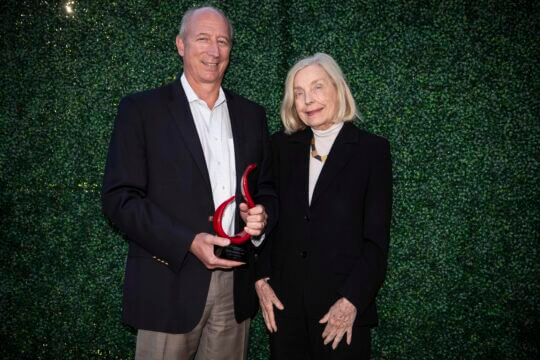
The research challenges the long-held belief that the adaptive immune system plays little role in neurodegenerative diseases of the brain. For the first time, it demonstrates that T cells — immune cells normally found outside the brain — are involved in neurodegeneration, opening new avenues for potential therapeutic investigation.
“Both Xiaoying Chen and I and our many outstanding co-authors are very honored to receive recognition for the work in our recently published paper. There remain many unanswered questions about the exact role of the adaptive immune response in the pathogenesis of Alzheimer’s disease. I think this work along with work from others in the field is pushing us to understand how important adaptive immunity is in Alzheimer’s disease and other tauopathies, as well as whether targeting it will ultimately be therapeutically beneficial to people.” — David M. Holtzman, M.D.