Alzheimer’s is closely tied to aging, but not all aging leads to disease.
This conversation brings together CureAlz leadership and members of the Brain Aging Consortium to discuss the biology of brain aging and share recent scientific advances.
This one-hour discussion will be moderated by CureAlz CEO, Meg Smith, and concludes with audience Q&A. We welcome you to submit questions in advance by emailing [email protected].
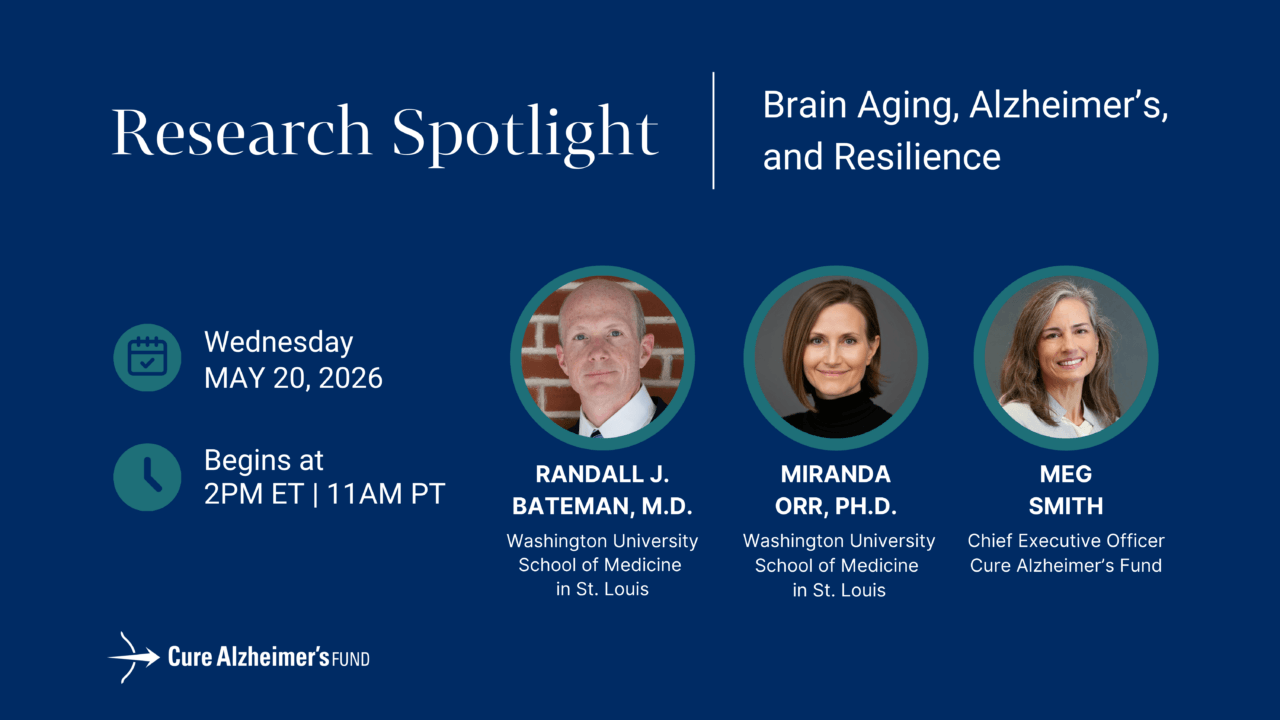
“Research Spotlight: Brain Aging, Alzheimer’s, and Resilience”
Date: Wednesday, May 20, 2026
Time: 2PM ET | 11AM PT
Register here
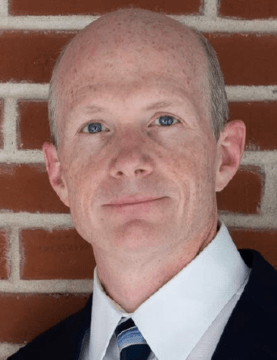
Randall J. Bateman, M.D.
Charles F. and Joanne Knight Distinguished Professor of Neurology; Director, DIAN and DIAN-TU | Washington University School of Medicine in St. Louis
Dr. Bateman received a B.S. in Electrical Engineering and B.S. in Biology from Washington University and M.D. from Case Western Reserve University School of Medicine. He completed Neurology residency at Barnes Jewish Hospital and postdoctoral research at Washington University School of Medicine. Dr. Bateman is the Charles F. and Joanne Knight Distinguished Professor of Neurology, Director of the Dominantly Inherited Alzheimer Network (DIAN), and Director of the DIAN Trials Unit (DIAN-TU). Dr. Bateman’s research focuses on the pathophysiology and development of improved diagnostics and treatments of Alzheimer’s disease. Dr. Bateman’s lab accomplishments include pioneering the central nervous system Stable Isotope Labeling Kinetics (SILK) measurements in humans, furthering insights of human circadian patterns of amyloid-beta and soluble APP, and human in vivo control of the alpha-secretase, beta-secretase, and gamma-secretase processing of amyloid-beta. His lab has developed methods to quantify the pharmacodynamic action of drugs targeting amyloid-beta, amyloid precursor protein, and Apolipoprotein E. Dr. Bateman’s research in DIAN has provided evidence for a cascade of events beginning decades before symptom onset that leads to AD dementia. He has received a number of awards including the Beeson Award for Aging Research, Alzheimer’s Association (Zenith Award), Scientific American, Chancellor’s Award for Innovation and Entrepreneurship (Washington University), the Glenn Award for Aging Research, and the MetLife Foundation Award for Medical Research. Dr. Bateman has been the primary mentor for junior faculty, clinical fellows, post-doctoral researchers, and graduate and medical students, who have been successful in their desired scientific careers.
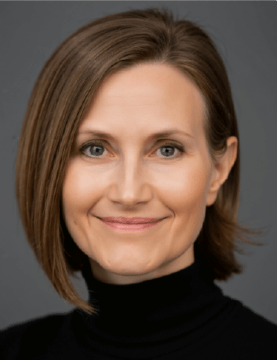
Miranda Orr, Ph.D.
Associate Professor, Neurology | Washington University School of Medicine in St. Louis
Dr. Miranda Orr is an Associate Professor of Neurology at Washington University in St. Louis and a Research Health Scientist at the W.G. (Bill) Hefner VA Medical Center, Salisbury, NC. She is a translational neuroscientist with expertise that spans the biology of aging and tau-associated neurodegeneration. A primary goal of her research is to understand cellular and molecular processes driving neurodegeneration and cognitive impairment during the prodromal period associated with Alzheimer’s disease and related dementias. Her career has focused on tau neurobiology and its role as a cellular stress response at the intersection between healthy brain aging and neurodegeneration. Using this strategy, her laboratory has identified a link between tau pathology and cellular senescence, the quintessence of latent tissue degeneration. This seminal finding has laid the groundwork for further investigation into post-mitotic cellular senescence, a newly recognized neuronal cell fate; the interaction between fundamental cellular aging processes and neuronal pathology; and clinical trials using therapeutics to clear senescent cells.
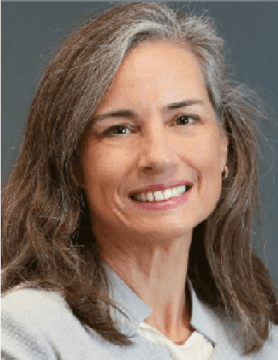
Meg Smith
Chief Executive Officer | Cure Alzheimer’s Fund
Meg Smith is the Chief Executive Officer of Cure Alzheimer’s Fund, a non-profit organization dedicated to funding research with the highest probability of preventing, slowing or reversing Alzheimer’s disease. Meg was appointed CEO in 2023 after eight years of successfully advancing the research program at Cure Alzheimer’s Fund. Through her stewardship, the fund awarded more than $138 million in research grants to scientists and institutions worldwide, representing a substantial portion of the total distributions since the organization’s inception in 2004. Meg spearheaded unprecedented year-over-year growth while simultaneously ensuring that CureAlz sustained its model of high-rigor, high-accountability scientific decision making by its external community of leading researchers.
This funding has been instrumental in driving progress and fostering groundbreaking discoveries in Alzheimer’s disease research. Among the notable achievements under Meg’s leadership is an extraordinary 7.8x return on CureAlz investment into proof-of-concept, early-stage research from the National Institutes of Health, multiplying the impact of the organization’s contributions to Alzheimer’s research.
Trained as an attorney and with expertise in business consulting, Meg brings a unique and pragmatic perspective to the organization. She has earned widespread respect within the research community for her collaborative strategy, dynamic vision and impressive mastery of the science. Prior to her role as Executive Vice President, Research Management, for Cure Alzheimer’s Fund, Meg was a consultant with McKinsey & Company and a law clerk for the Massachusetts Supreme Judicial Court. Additionally, she has served as a Fellow at The Berkman (now Berkman Klein) Center for Internet & Society at Harvard University. Meg earned a Juris Doctor degree from Harvard Law School and a Bachelor of Science degree from Duke University.