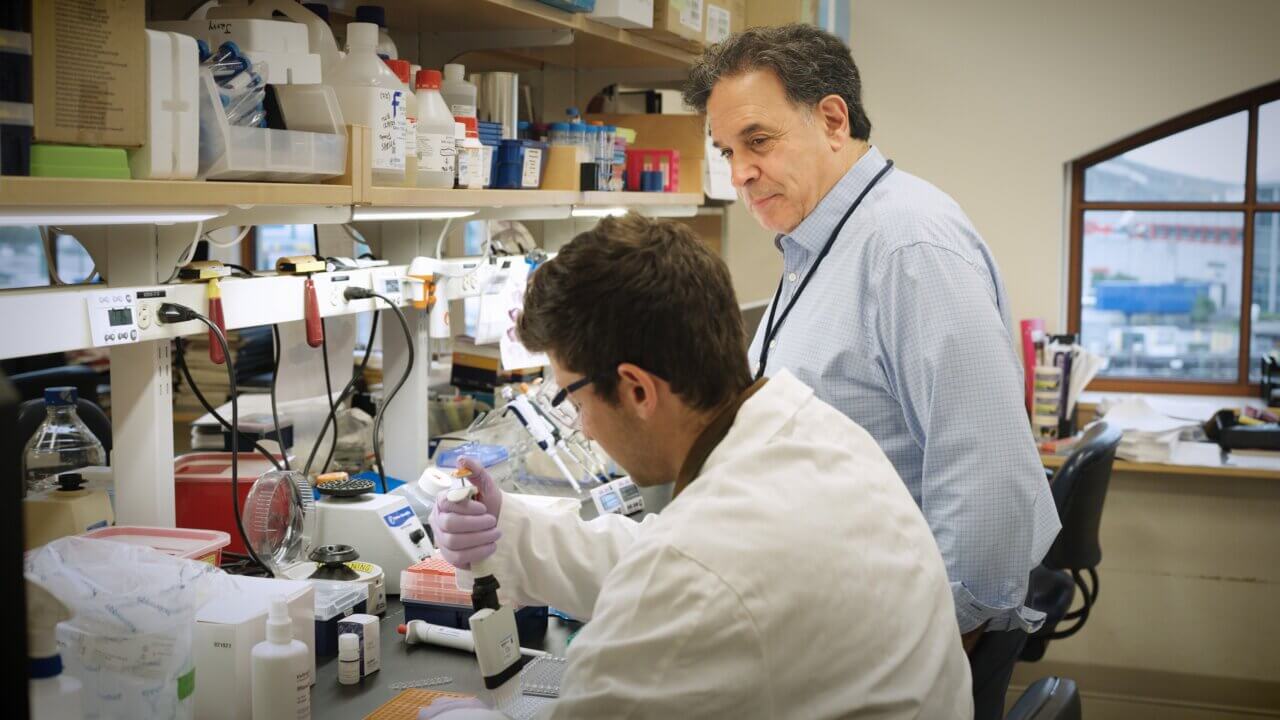
Rudolph Tanzi, PhD, Chair of the Cure Alzheimer’s Fund® Research Leadership Group, and his colleagues at Mass General Brigham have been awarded up to $41 million over three years by the Advanced Research Projects Agency for Health (ARPA-H). The award will enable clinical trials to evaluate combinations of repurposed FDA-approved drugs and natural products aimed at preventing or slowing Alzheimer’s disease progression.
More than a decade ago, CureAlz funded the foundational research that led to the development of the groundbreaking laboratory model called Alzheimer’s in a Dish, which enables scientists to study the disease in human brain cells. This became an invaluable tool for screening natural products and drugs approved by the FDA for other diseases for potential effects on Alzheimer’s. The candidates identified as most promising by that early work and further validated by lab studies will now be tested in human clinical trials funded by ARPA-H.
The road to this award took decades. It required not only scientific dedication but also ongoing financial support by funders not motivated by profit to advance the ideas and data necessary to progress to clinical trials.
CureAlz is proud of its role in this journey.
Where it Began: Alzheimer’s in a Dish
In the early 2000s, Alzheimer’s researchers faced an intractable problem: the mouse models they had developed to study the disease did not produce the same pathology seen in humans. While the mice produced amyloid plaques, they never developed tau tangles.
We now know mice and humans make slightly different versions of tau proteins, and mouse tau protein is not prone to developing tangles like human tau protein. However, at the time, researchers did not know if their model was at fault or if the amyloid cascade hypothesis — which posits that amyloid plaques induce tau tangles and cell death — was wrong.
Doo Yeon Kim, PhD, with support from Dr. Tanzi, believed a human cell culture model of Alzheimer’s could better illustrate what happens in the human brain, and he believed he could create it. However, he struggled to secure funding to support his idea. CureAlz stepped forward to fund his work when other organizations were unwilling to take the risk.
The result of that investment was Alzheimer’s in a Dish, and it provided scientists with a 3D human cell culture model that, within six weeks, reproduced the hallmark amyloid plaques and tau tangles of Alzheimer’s and provided evidence supporting the amyloid cascade hypothesis.
Putting the Tool to Work: Alzheimer’s Disease Drug Discovery & Development Consortium (AD4)
This new model condensed 10-30 years of disease progression into six weeks. Its size meant lab analytical technology could assess 96 individual models simultaneously. Suddenly researchers could test 96 different interventions simultaneously in human-derived models and assess the outcomes in a matter of months instead of testing interventions one by one in mouse models over years. The acceleration of discovery was extraordinary, and the implications for drug discovery were immediate.
The CureAlz AD4 Consortium utilized Alzheimer’s in a Dish to test thousands of existing FDA-approved drugs and natural products — compounds derived from plants, fungi, and other organic sources — for their effects on disease pathology. Rather than develop new medications from scratch, this approach tests drugs and natural products already proven safe for humans that might be effective against Alzheimer’s.
The Consortium identified several promising candidates. However, although these candidates showed positive effects in human cells, that information did not automatically mean the same benefits would be seen in patients or indicate what dosage would be safe or effective. This is why clinical trials specifically for impact in Alzheimer’s are still necessary.
CureAlz supported the foundational research that created the Alzheimer’s in a Dish model as well as the early screening that identified candidates for further investigations. This work generated the evidence needed to attract additional investment from the NIH and other funders.
Now, ARPA-H has stepped in to support the clinical trials.
Why CureAlz’s Unique Funding Model Works
CureAlz supports high-risk, high-reward foundational research. We fund the spark — promising ideas — that others may consider still too risky to support. CureAlz identifies researchers with bold plans and well-thought-out experiments and then gives them the financial support they need. By doing so, we create opportunities for discoveries and collaborations that lay the foundation for continued studies. Researchers leverage the data they’ve gathered to secure follow-on support from larger government funders, such as the NIH and ARPA-H, and from for-profit organizations for commercial exploration.
From 2018 to 2022, every $1 CureAlz invested in research became $7.30 in follow-on funding from the NIH.
Alzheimer’s in a Dish, the AD4 Consortium, and Drs. Tanzi and Kim’s work are great examples of the success of CureAlz’s model and of how we fit into the broader funding ecosystem. Scientific progress requires complementary funding sources at different stages of the research process. CureAlz plays a vital role as an early enabler, de-risking ideas so that other funders will have incentive to provide support for further development.
The Potential of the ARPA-H Award
Dr. Tanzi and his colleagues will test FDA-approved drugs and natural products that, in laboratory settings, have shown promise for slowing or preventing Alzheimer’s disease progression. The researchers will use a platform clinical trial approach. In platform trials, one group taking a sham drug (placebo) is used as the comparison standard for multiple participant groups, each taking a candidate compound or combination of compounds. The placebo group is maintained over time, with participants cycling in and then out, while the trials of different candidate compounds run their course. Because the trial infrastructure is maintained rather than being established for each drug candidate in turn, platform trials bring powerful efficiency and flexibility to the clinical trial process.
The research will be conducted through Mass General Brigham Neuroscience Institute’s McCance Center for Brain Health, where Dr. Tanzi serves as director.
The Need for Rigorous Testing of Natural Products
The origins of pharmacology are deeply rooted in natural products, and many of the active ingredients in drugs used today were originally derived from organic sources. Several everyday examples exist: aspirin comes from willow bark, pain medications have origins in poppy flowers, and statins and penicillin were discovered from fungi. There is value and precedent for exploring the potential of natural products in treating Alzheimer’s disease.
However, most natural products have not undergone the same stringent testing as pharmaceuticals to determine if they are safe or effective at any or at a specific dose. Walk into any pharmacy or drugstore, and you can find numerous natural products, some of which are marketed to people worried about their memory or brain health. But because natural products cannot be patented or sold exclusively, for-profit companies do not have the financial incentive to undertake the massive cost of testing them.
This creates a gap. Many natural products are readily available and relatively inexpensive, but their safety and effectiveness for treating Alzheimer’s have not been thoroughly studied.
The ARPA-H award fills this gap and supports the rigorous research needed to determine what is safe and effective.
One Part of a Larger Story
We celebrate Dr. Tanzi and his colleagues on their ARPA-H award and are proud of the key role CureAlz played in the journey that has brought them to clinical trials.
Dr. Tanzi is only one of many researchers supported by CureAlz. To date, we have funded 420 researchers and invested more than $280 million in their ideas. We are eager to support their journeys and to see where they take them.
But just as research is a collaborative effort, so is the financial support required to make it happen. Continued donor support is essential. Many promising scientific ideas still need the early investment required to determine their potential. Together with our donors, we can help scientists find solutions that will bring us closer to a cure.
Learn more about how you can help advance promising opportunities to accelerate scientific progress.
Ways to Donate