We spend nearly a third of our lives sleeping. It’s an activity we are all familiar with, yet if asked to define sleep, we might struggle to answer. We spend that time unconscious and immobile. Upon waking, we have little to no memory of what happened during the hours we slumbered. So, what is sleep?
For this discussion, we will narrow our focus to humans, because although all creatures do something that looks like sleep, how they do so can vary wildly.
The Stages of Sleep
Humans are programmed to sleep every night. As darkness falls, the brain sends signals to the body that it is time to sleep. We lie down, close our eyes, and ideally spend the next six to eight hours unresponsive to the outside world. Because we can’t describe what happens during this time, what we know comes from measuring the brain’s activity and the body’s behavior.
Sleep is divided into two broad categories based on eye movement: non-rapid eye movement (NREM) sleep and rapid eye movement (REM) sleep. NREM is further subdivided into three stages.
NREM Stages
Stage 1: The Transition (N1)
5% of total sleep
This is the transition from wakefulness to sleep.
Muscles begin to relax. Heart rate and breathing slow. Body temperature drops about 1°F. This is the lightest stage of sleep, where it might feel like one foot is in the waking world and the other is in the dream world. You are easiest to wake in this stage.
During this period, you might experience muscle twitches or feel like you are falling and jerk awake because the skeletal muscles have not fully gone offline yet.
Stage 2: The Preparation (N2)
45% of total sleep
This stage prepares the body for deep sleep.
Body temperature continues to drop. Heart rate and breathing become more regular. Overall brain activity slows, and large populations of neurons begin to synchronize and fire together, with occasional but brief bursts of activity that indicate the brain is creating a sensory barrier to the outside world. This is handled by the thalamus.
To stay asleep, the brain must ignore the sounds around us. When we are awake, the thalamus works as a relay station, processing information from our senses and directing it to the appropriate brain region to be acted on. But when we are asleep, it reduces the flow of information to our brain, which lowers our awareness of the environment and prevents us from being easily woken.
Stage 2 sleep, along with the next stage, plays a role in memory consolidation — the process of stabilizing fragile, short-term memories into long-term ones.
Stage 3: Deep Sleep (N3)
25% of total sleep
This is the deepest and most restorative stage of sleep.
Body temperature has dropped by 1-2°F. Breathing and heart rate reach their lowest levels. On an EEG (electroencephalogram) — an instrument that measures the brain’s electrical behavior — the brain’s activity looks like large, slow, rolling waves, which is why this stage is also called slow-wave sleep.
It is very difficult to be awakened during this stage. If you are, you will suffer from sleep inertia, or mental grogginess, and the effects can last for up to an hour.
This period is crucial for physical restoration and growth. Your body repairs and maintains muscles, bones, and tissues. The brain undergoes a deep cleaning, and the immune system gets a boost. This is when overall health is supported.
REM Sleep: Active Sleep
25% of total sleep
REM sleep departs from the restful, restorative sleep of NREM.
On an EEG, the brain looks awake. Neurons that were firing together in deep sleep to create slow, rolling waves now fire independently, producing short, jagged spikes and sawtooth-like waves. The brain is lit up with activity. This creates an environment for dreams to come alive.
Visual areas of the brain fill the mind with images while memory-related regions, like the hippocampus, contribute fragments of past experiences. The amygdala, or emotional center of the brain, drives intense feelings. Even the parts of the brain that send signals to our muscles are firing. To prevent us from acting out our dreams, we are temporarily paralyzed through a process called REM atonia, where the brainstem sends signals that turn off the motor neurons in our spinal cord. Only our eyes are left to dance beneath our lids as a characteristic feature of this sleep stage.
While many areas of the brain are engaged during REM sleep, the rational, logical part, called the prefrontal cortex, stays mostly “asleep,” making way for the often bizarre and fantastical experiences of our dreams.
REM sleep supports memory, learning, and creativity. It is also when the brain processes emotional experiences, seemingly separating the factual event from its emotional charge so the feelings around the event soften. This overnight processing may also help reset our emotional reactions to an appropriate level for the next day. If you don’t get enough REM sleep, your body will try to make up for it the next night.
The Sleep Cycle
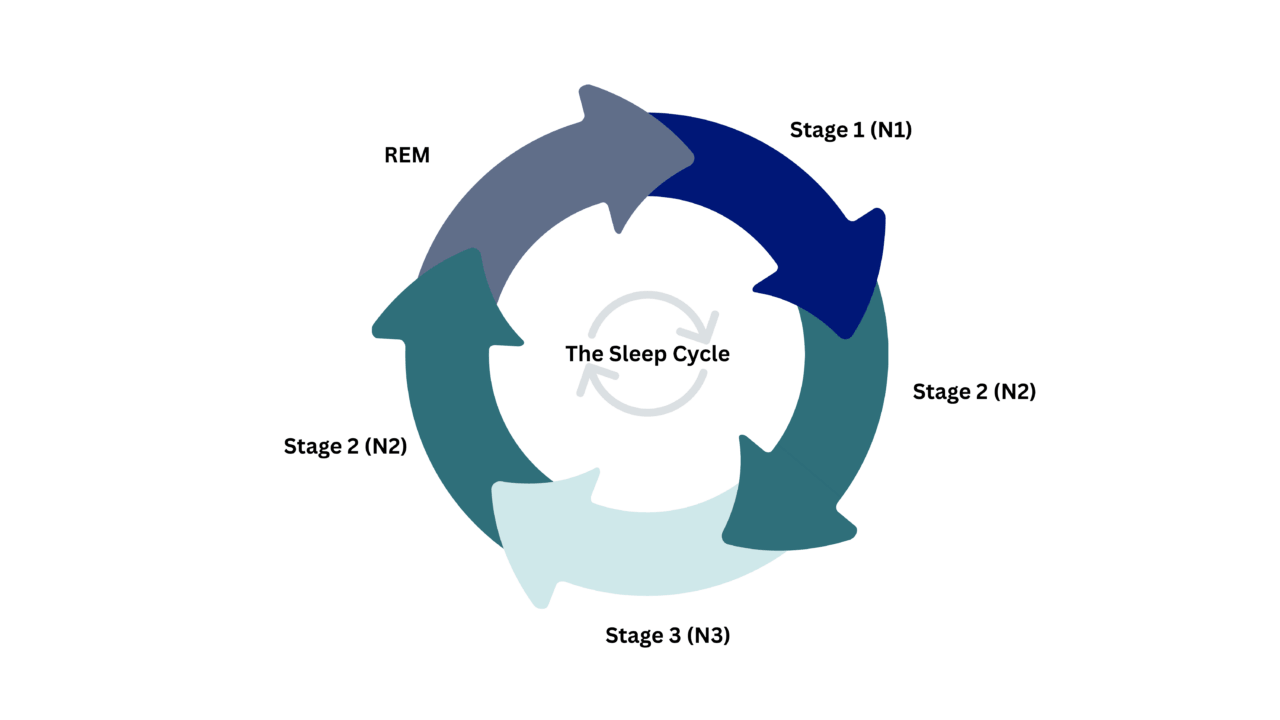 Each night, we cycle through the sleep stages in the order shown in the image above. Notice that we enter Stage 2 both before and after Stage 3. A complete cycle takes roughly 90–110 minutes, and, ideally, we go through four to five sleep cycles each night.
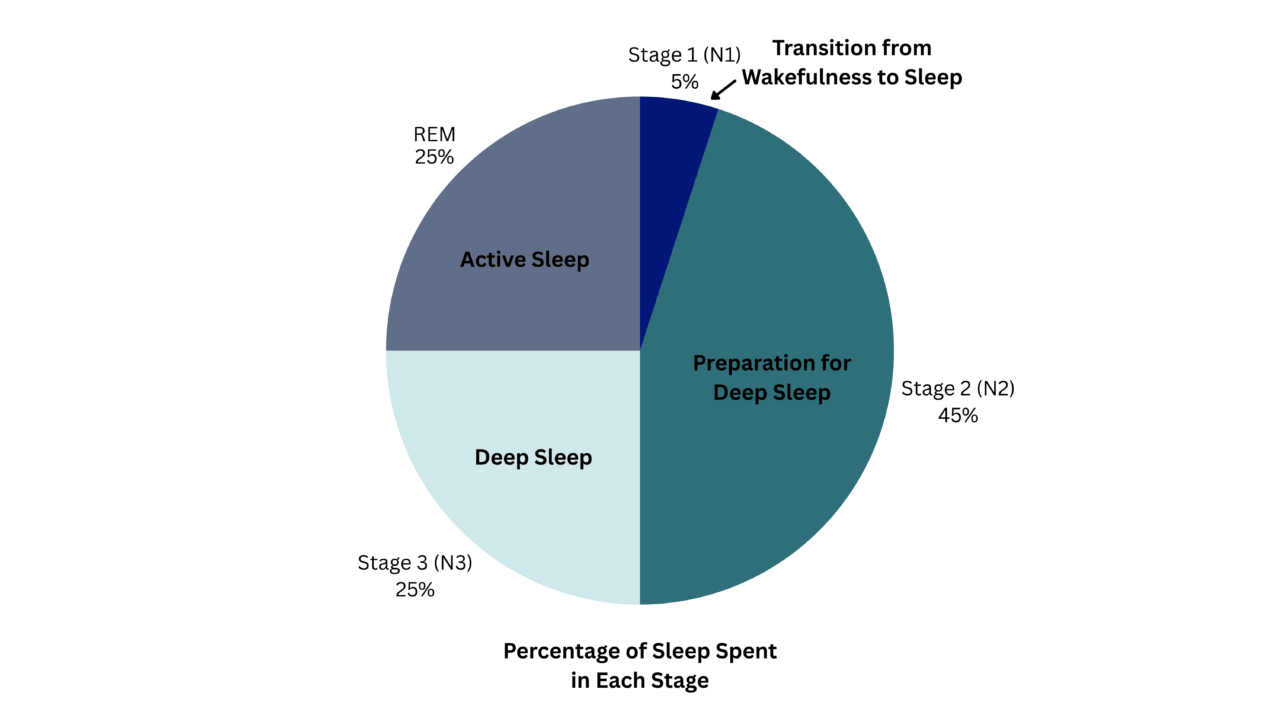
About 75% of sleep is NREM, with the remaining time spent in REM. Most of our sleep (45%) is in Stage 2. Stage 3, when our body focuses on repair and overall maintenance, accounts for 25%. Unfortunately, as we age, we spend less time there.
The amount of time we spend in REM gets progressively longer with each cycle. In the first cycle, REM lasts only about 10 minutes, but by the last cycle, we may spend 30 to 60 minutes in REM.
The Mystery of Sleep
Despite all we have learned, scientists still consider sleep mysterious because two key questions remain unanswered: Why do we sleep the way we do — unconscious and immobile — and why is sleep essential for our survival?
The Cost of Sleep
Sleep costs humans quite a lot.
When we sleep, we are insentient and temporarily paralyzed, leaving us vulnerable. While this cost may seem low in our modern world, it was not always so. Sleep was a survival risk — and still is for humans and non-human animals in the wild. An unconscious animal can’t watch for threats. Senses and awareness of the outside world are muted or blocked. Environmental changes, like fires, flooding, or temperature shifts, that would be immediately noted by an awake animal are ignored by a sleeping brain until they break through the self-built barriers, at which point it might be too late.
Not only is there a survival cost, but there are also opportunity costs. An adult human spends 25 to almost 40% of each day sleeping. During that time, one cannot hunt or gather food. Sleeping is time lost for learning, socializing, and mating. In our modern world, these costs seem low, but to put it in perspective, humans evolved to sleep this way when these costs were extraordinarily high. The persistence of how we sleep suggests that the payoff must be worth the cost. This leads us to the second mystery:
What Makes Sleep Essential for Survival?
Despite its cost and danger, no known animal has evolved not to sleep. Sleep loss, even in the short term, has mental and physical health consequences, and complete sleep deprivation is fatal. While there is no question that sleep is beneficial, so far, none of its benefits have been identified as the reason we must sleep.
In fact, the benefits — memory consolidation, immune support, brain cleaning, repairs, etc. — may be side effects of the as-yet-unidentified non-negotiable reason we sleep.
Solving this mystery has proved challenging.
First, sleep cannot be isolated from its benefits. They are bundled together, and there is no clean way right now to separate the cause from correlation. We also cannot isolate sleep stages and study them independently, so we can’t determine which stage is home to the reason that we sleep.
Second, experiments compare a group that does the behavior, like sleep, with one that doesn’t. However, depriving an animal of sleep as a control is not the same. It muddies the water, because sleep deprivation causes its own problems. Even if a naturally occurring control group existed, it still wouldn’t solve the first challenge: sleep, its stages, and all its benefits, are bundled and can’t be isolated individually.
Can We Answer the Question: What is Sleep?
Scientists are making progress in untangling the mysteries of sleep, but we may never fully understand why the cost is so high or the reason it is essential for our survival. Still, we can describe what happens to the brain and body while we sleep, and what that time makes possible: memories are formed, the body repairs itself, and the brain clears away waste. That no animal has evolved to go without some form of sleep tells us it is undeniably important, and we have ample evidence that sleep disruptions have consequences for our brain and overall health. Short-term disruptions lead to brain fog, memory issues, and irritability, while long-term disruptions are linked to numerous health problems, including mental health issues and chronic diseases.
Sleep and Alzheimer’s disease
Sleep and Alzheimer’s disease are linked in ways scientists are still trying to understand. Early in the disease, people with Alzheimer’s often have trouble sleeping, sometimes before memory problems appear, and sleep disturbances tend to worsen as the disease advances. However, it is not clear whether sleep disruptions lead to the disease or whether the associated brain changes damage the brain in a way that interferes with sleep. It could also be a combination of both.
Brain waste clearance is another reason sleep is a focus of Alzheimer’s research. It occurs during stage 3 sleep, which is the stage that gets shorter as we age. During this stage, the brain is cleared of waste, including the amyloid and tau proteins associated with Alzheimer’s. If sleep is fragmented or disrupted, the brain doesn’t get cleaned the way it should, allowing these toxic proteins to accumulate.
Understanding whether sleep changes are a warning sign, a contributing factor, or both could reveal new ways to protect the brain over a lifetime. To pursue this topic, Cure Alzheimer’s Fund® convened the Sleep & Circadian Rhythms Consortium in April 2026. Its goal is to explore how sleep and the internal rhythms that regulate it relate to Alzheimer’s, and to determine whether improving or protecting sleep could reduce the risk of the disease, slow its progression, or prevent the disease entirely.
CureAlz provides medical and scientific information for general educational purposes only and does not endorse or recommend any specific diagnostic tool, physician, clinical trial, or treatment. Because the field is changing rapidly, the information provided may not be fully current. Please partner with your doctor or other qualified medical professional to determine the best medical and health options for your personal medical situation.